
Thursday October 1st – Saturday October 3rd, 2026
EUROPE IN DISCOURSE V: A DEBATE ON PARTITION OR REINTEGRATION
Conference Description
Europe in Discourse (EID) V will take place in 2026 (October 1st - October 3rd) and will build on the tradition of the previous four rather successful international conferences. Europe in Discourse V will engage critically with the profound and structural crisis currently affecting the European Union is facing, one that challenges its cohesion, strategic autonomy and global role. Once again, the foundational elements that have been informing Europe in Discourse I to IV such as values, history and borders will undeniably continue to be present in Europe in Discourse V.
Europe is navigating a highly complex organic crisis: the second Trump Administration is further weakening the transatlantic alliance, replacing traditional isolationism with a new form of assertive exceptionalism that threatens the foundations of global economic, social and security governance. Historically, two key pillars have underpinned the transatlantic relationship: security and economic integration. Both are now under strain. First, defense is put under threat by the US announcements that Europe should increase its defense spending and recalibration of burden-sharing. Second, the aftermath of protectionist policies—especially the trade tensions initiated during President Trump’s first term—has significantly disrupted EU–U.S. relations and undermined confidence in open, rules-based trade.
In this context, Europe needs to redefine its narratives and strategies while restructuring and allocating its internal resources. Priorities in both external relations and domestic policies are shifting in many fields, including security as Europe increasingly finds itself without a transatlantic unified defense strategy. To resist and adapt to these pressures, Europe is called upon to act decisively, to boldly reimagine the core elements of its identity, and to revisit its alliances and global partnerships.
Europe in Discourse (EID) will place particular emphasis on the relationships between Europe and the Global South, using this lens as a transversal perspective across the conference’s thematic axes -- values, history and borders. This focus reflects a growing recognition that, despite its complex and contested nature, the term Global South has demonstrated enduring relevance since its first emergence in 1969. Today, it encompasses a highly diverse set of countries with varying development paths and interest across Africa, the Middle East, Asia, Oceania, Latin America, and the Caribbean. Within this heterogeneity, new geopolitical dynamics are taking shape. Asian powers such as China and India – long linked to Europe – are redefining their engagement through large scale initiatives. China’s Belt and Road initiative and India-Middle East-Europe Economic Corridor (IMEC) are reshaping connectivity and influence. Meanwhile, African geographical proximity and growing demographic and economic weight make its relationship with Europe both immediate and strategic. Exploring these interconnections is central to understanding Europe’s evolving global position.
The interaction between Europe and the Global South is shaped by a complex web of historical, economic, and cultural elements—including religious traditions. These interactions are marked by diversity rather than convergence, and understanding them requires attention to the multiple ways in which belief systems have evolved and intersected. In Africa, for instance, religious practices have often developed in response to colonial legacies, while in other parts of the Global South—such as the Middle East and South Asia—Islamic traditions play a central role. Europe, with its own evolving religious landscape, is both shaped by and responding to these global currents. Europe in Discourse V aims to foster dialogue and mutual recognition, exploring how shared spaces can emerge across cultural and religious diversity. This approach seeks to move beyond binary oppositions, focusing instead on the conditions for coexistence and collaborative engagement.
Institutions also play a role in the current landscape: the UN, for instance, remains hamstrung by structures rooted in post-WWII power relations and a financial dependency on a few dominant actors. Therefore, on which basis could multilateralism be reformed? How should it gain more legitimacy given the growing agency of the Global south? What should be its goals that cannot be confined to growth and security? What modalities should it adopt?
All this drives the conclusion that there are regions and countries which are part of the Global South, and which can function as accelerators for the new Europe. As such they can provide a meaningful backdrop against which Europe can measure itself, re-assess its partnerships potential and move forward in a steadfast way to re-invent itself.
While the previous Conferences took place in general context of global stability now we need to go back to the drawing board to redo Europe. During the previous Conferences we were discussing Europe from a safe ground. When we were discussing the Global South as a key theme for Europe in Discourse V this was done under conditions of stability, to put more emphasis on borders, values and history through the lens of the Global South. Now, this discussion needs to be more profound and have a discussion on Europe’s own identity. At the same time, we see countries or pockets of the so-called Global South as a key partner(s) to the EU and critical for partnerships potential with Europe which can venture towards a quest for reintegration.
Nonetheless, the current conditions and dilemmas brought before Europe guide the theme of the Conference Europe in Discourse: The Debate on Partition or Reintegration. The discussions that will emerge from keynote addresses and panel debates are going to be centered around the centripetal and centrifugal forces which compete against each other and impact the future of Europe. On the one hand the centrifugal elements of the organic crisis mentioned above are pushing towards partition and fragmentation while on the other hand there are the centripetal cohesive forces of shared culture, the commitment for maintaining peace in the continent but also shared interests for the future drive reintegration. The debate about Europe as well as the policies in action that will be set in motion by the European Union will largely inform and shape the future of Europe.
Call for Papers to be shortly announced.

 Lindy holds a BA in Criminology & Education, a Post Graduate Certificate in Western Esotericism, a Master of Science in Transpersonal Psychology and Consciousness Studies and a Ph.D. in Educational Psychology. She also holds Diplomas in Mindfulness, Regression Therapy, Biotherapy, Stress Management and is a European certified Transpersonal Psychotherapist. Lindy began her research primarily with the study of children suffering from mental and physical challenges in South Africa, carrying this through into researching learning challenges when she moved to Greece. She began to avidly explore the psyche through Depth Psychology and Neuroscience, with her research extending into developing techniques through the role of Myth and Archetypes in personal, professional and transpersonal development. Her Ph.D. research has been published by Cambridge Scholars under the title Therapeutic Keys to Self-Actualization in Homer’s Demeter. Her current research interests involve transgenerational wounding and the role that Integrative Psychology plays in the healing of trauma. Lindy is an Associate Professor, Supervisor and Director of the Hellenic American University Psychology Department.
 Maria Agorastou holds a Master’s degree in Social Work and a Ph.D. in Education from the University of New Hampshire and is a certified applied behavior analyst. She has extensive experience working in public schools in New Hampshire in applied research projects on inclusion, school climate and drop-out prevention, Response to Intervention (RTI), cognitive behavioral and existential therapy, as well as mindfulness and anxiety disorders. She is currently an advisor to the Network of Special Schools and a regular guest lecturer at schools and municipalities across Greece on the topics of behavioral analysis, inclusion, and teacher training. She is an adjunct faculty member for Hellenic American University’s undergraduate and graduate psychology programs, teaching courses in cognitive behavioral therapy, educational psychology, learning and behavior as well as clinical and developmental linguistics and disability and inclusion in the MAAL and BAELL programs. She also serves as a clinical supervisor to graduate students. Currently, she is the Coordinator of Counseling Center.
 Dr. George Lagios holds a Master’s degree (MSc) in Mental Health Counseling from Hellenic American University (Athens campus). In 2022 he got his PhD in Sexology from the International Umiversity of Bircham and has certifications with honors in Sex Addictions, Sexual Abuse and in Psychosexual Therapy. George is the author of two Best Sellers: Would you choose yourself as your parent?, published in 2019 and Inside Your Mind”, which was published in 2021. He frequently writes on psychological topics which are published in the press and on the internet, and he has been given the “Academic Achievement Award” (2020) from Hellenic American University. He is also a public speaker and organizes webinars on topics such as parental responsibility, financial stress, the importance of sharing, and sex disorders. He is currently in private practice, working psychotherapeutically with adults. He also as an active humanitarian action as the ex-president and co-founder of “moirazomai.gr”, as a scientific associate of “Diadrasis”, and as an advocate for gender equality, as well as for the prevention and management of violence against women.
 Panayotis Kalozoumis is an Assistant Professor of Physics and Applied Mathematics and Director at the Research Institute of the Hellenic American University. Holding a PhD in Physics from the National and Kapodistrian University of Athens, he has worked as a full-time researcher for several international and Greek research centers and Universities. He is author/co-author of 25 publications in peer-reviewed journals and his work has been presented in multitude of international conferences and workshops. He is also a referee for seven scientific journals. His research interests focus on nanophotonics, wave control in aperiodic media, quantum optics and quantum information. Dr. Kalozoumis collaborates closely with the Department of Material Science in the University of Patras, the Physics Department of the University of Athens, the Center for Optical and Quantum Technologies in Hamburg (Germany), the Laboratoire d'Acoustique de l'Université du Mans in Le Mans (France) and he is member of the
  A “technology architect”, a “team leader”, an information system and a digital transformation specialist with a passion exceptional aptitude for working with computers combined with an astounding academic background in computer and software engineering (PhD) and business management (MBA). He is also teaching and researching of innovative systems and platforms and he is specialized in Geographical Information Systems. Over the last eight years he has been specializing in Internet of Things (IoT), Big Data, Artificial Intelligence (AI) and Blockchain platforms in shipping industry as CIO at a top-performing maritime company, as Adjunct Professor at University of Thessaly and as an Adjunct Professor in the Information Technology and Engineering Programs at Hellenic American University.
 Didoe Prevedourou holds a master’s degree in Computer Science and Electrical Engineering from Northwestern University, Evanston, Illinois, USA. Didoe is currently the Director of Innovation in ICT at the Hellenic American University and College. She is mainly responsible for the organization and coordination of the funded research and innovation management activities. She is also Vice President of Innovation and Research at the CTiF Global Capsule, a global, collaborative, non-profit organization for cross-/inter-disciplinary research, education, and innovation. Didoe has a vast working experience in both academic and corporate environments. During 2014-2020, she served as the Managing Director of AIT, a private non-profit research organization, and before that, for twelve years, as AIT’s Research Director mainly responsible for the administration and organization of AIT’s activity, research fund raising, research collaborations and partnership formulations, as well as for the protection, dissemination and commercialization of AIT’s intellectual capital. During 1991 – 2001, Didoe served in various research and managerial positions at INTRACOM S.A., the biggest Hellenic Telecommunications Industry. She was also INTRACOM’s representative at the European Telecommunications Standards Institute (ETSI), and a representative of the Greek Industrial Confederation at the Telecommunications Working Group of the Union of Industrial and Employers’ Confederations in Europe (BUSINESSEUROPE). Didoe has worked as research scientist in numerous EU and nationally funded research projects, also in the roles of project coordinator and technical manager, as well as in industrial projects, covering diverse thematic areas in ICT and innovation management. Her research interests are in ICT and its applications in healthcare, education, and culture.
 Dimitris Zoakos received his PhD in Theoretical/Mathematical Physics from the University of Patras, Greece. He has worked as a postdoctoral researcher for more than ten years for both international and Greek Universities, including the University of Santiago de Compostela (Spain), the University of Porto (Portugal), the International University of Catalonia (Spain) and the University of Athens (Greece). His research interests focus on High Energy Physics and String Theory. He has published several papers and conference proceedings in high-impact-factor peer-reviewed journals and he is a referee for some of the most prestigious journals in the field of Theoretical High Energy Physics. More information
 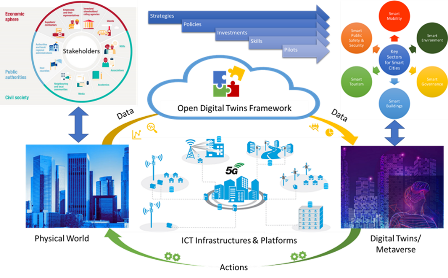 MetaCities proposes to create an Excellence Hub that spans a large geographical area, that of Southeast Europe. It involves three place-based innovation ecosystems in Cyprus, Greece and Bulgaria, each consisting of all types of partners in a Quadruple Helix model (i.e., academia, industrial, societal, public). The thematic focus of the Hub is future, metaverse cities and involves ambitious research and innovation (R&I) agendas and the uptake of advanced digital technologies. The project will define Digital Twins (DT) of future cities/regions that will provide accurate and reliable reference representation seamlessly unifying the physical, digital and human worlds and enabling stakeholders to assess the effects of any changes before investments and implementations actually occur. Specific domains with strong social footprint are selected as reference pilot implementations in order to guide and validate the proposed framework in the three participating ecosystems. The Greek Pilot focuses on Smart Mobility in the region of Patras. Detailed mobility use cases will be designed, and digital twins will be identified and described representing characteristic mobility cases of the city. The Bulgarian Pilot deals with Smart buildings and Energy efficiency in the region of Burgas. Indicative use cases include potential uses of renewable sources of energy (PV), budget planning for energy usage and buildings renovation. The Cypriot Pilot deals with Smart Urban Planning. It will make use of interactive and immersive technologies to visualize and understand smart city data. Innovation excellence will be strengthened in the involved place-based ecosystems through cross-border collaboration in the selected domain of cutting-edge science and innovation.
 P-ΝΕΤ Emerging New Generation Networks and Applications is a Competence Center in the Region of Western Greece. P-NET’s establishment has been approved by the General Secretariat for Research and Innovation (GSRI) of Greece in the framework of the Action «COMPETENCE CENTERS». The Action is co-financed by the European Union and Greece (EU European Regional Development Fund and EPAnEK Operational Program Competitiveness - Entrepreneurship – Innovation 2014-2020). It is implemented through the General Secretariat for Research and Innovation (GSRI), which also co-funds the first 24 months of P-NET’s operation.
 HOLOTWIN is a University twinning action for enhancing capacity and research excellence in Holographic TelePresence Systems (HTPS) as a catalyst of digitalization. It is funded by Bulgaria’s Ministry of Science and Education. The twinning will activate a process of knowledge transfer towards the Technical University of Sofia (Bulgaria), which leverages the academic and research excellence at Aarhus University (Denmark), University of Surrey (UK) and Hellenic American University/Hellenic American College (Greece) in this area of research. HTPS have a huge potential to elevate wireless interpersonal communication to new heights and to become the pillar of digital transformation of business and society. As a relatively new research field, there are still many open challenges requiring collaborative research effort to support both theoretical research and prototype laboratory experimentation. The HOLOTWIN plan of activities includes: staff exchanges, joint brain-storm meetings, research and scientific publications, workshops and summer schools, cross-functional mentoring, and training to empower researchers getting their innovations to the market. For more information about the project please contact Ms. Didoe Prevedourou, dprevedourou [at] hauniv.edu.